One of the principal aims of our Action, Distant Reading for European Literary History, is to build a multilingual European Literary Text Collection (ELTeC), ultimately containing around 2,500 full-text novels in at least 10 different languages. Today, we are pleased to announce the first public release of ELTeC, with nine language collections included!
The ultimate aim is for ELTeC is to provide multiple collections of 100 novels published between 1840 and 1920 in their original languages. Work to add more novels to ELTeC is ongoing, as we aim to build a corpus which will aid us in our task to develop the resources necessary to change the way European literary history is written. Progress towards our goal and current statistics about the collections can be found on this ELTeC Summary page: https://distantreading.github.io/ELTeC/
Language collections in this first release are in German, English, French, Italian, Norwegian (Bokmål and Nynorsk), Portuguese, Romanian, Serbian, and Slovenian. The collections can be downloaded here: https://zenodo.org/communities/eltec/
Each novel is encoded in compliance with the guidelines of the Text Encoding Initiative (TEI), and we have published details about the criteria for corpus composition and encoding guidelines here: https://distantreading.github.io/, and about our TEI schemas here: https://github.com/COST-ELTeC/Schemas/.
As work progresses on ELTeC, we invite you to use our collections. Feedback from the community would be very welcome as we improve our collections and work towards future releases. Please feel free to write to me or relevant Working Group Leader, Carolin Odebrecht with your comments, or submit to our GitHub issue tracker. If you are interested in becoming a member of our Action, find out more here: https://www.distant-reading.net/about/participate/.
Thanks to all of our colleagues from across Europe (and beyond) who have helped us to reach this important milestone!
https://www.distant-reading.net/wp-content/uploads/books-2273257_1280.jpg8681280Justin Tonrahttps://www.distant-reading.net/wp-content/uploads/distantreading_logo-high-300x138.pngJustin Tonra2019-11-20 16:06:252019-11-26 11:35:35Distant Reading Novel Collections Released in ELTeC Version 0.5.0
First call for Grant Period 3, for Missions occurring before March 31st, 2020.
COST Action “Distant Reading for European Literary History” (CA16204) is launching a new call for applications for Short Term Scientific Missions (STSMs). The deadline for applications is November 30th, 2019.
Our Action is particularly interested in the following topics, which are closely linked to the Action’s activities at the moment. Priority will be given to STSM applications regarding:
Producing EPUBs from ELTeC texts
Interface to ELTeC for search, filtering and download of texts
More texts for addition to the Action’s collection
Annotating training sets for UD pipe
Tackling Research Questions from WG3 to WG2
Applicants who are interested in one or several of the topics above should contact the Action’s STSM Coordinator (catherine.kanellopoulou@gmail.com) in order to obtain more information on them.
What is the COST Action “Distant Reading for European Literary History”? We aim to create a vibrant and diverse network of researchers jointly developing the resources and computational methods necessary to change the way European literary history is written. Fostering insight into cross-national, large-scale patterns and evolutions across European literary traditions, we will facilitate the creation of a broader, more inclusive and better-grounded account of European literary history and cultural identity.
What are Short-Term Scientific Missions (STSM)? STSMs aim to strengthen the existing COST Actions by allowing scientists to go to an institution or laboratory in another COST country to foster collaboration, to learn a new technique or to collect data using instruments and/or methods not available in their own institution/laboratory. They are particularly intended for Early Career Investigators (PhD students or researchers who received their PhD no more than 8 years ago).
https://www.distant-reading.net/wp-content/uploads/distantreading_logo-high-300x138.png00Christof Schöchhttps://www.distant-reading.net/wp-content/uploads/distantreading_logo-high-300x138.pngChristof Schöch2019-11-15 15:36:522019-11-15 15:37:361st Call for Short Term Scientific Missions (STSM) Applications in COST Action “Distant Reading for European Literary History” (CA 16204)
Distant reading, driven by the development of digital technology in the human sciences, has emerged as one of the most prolific approaches to literary texts. Maps, graphs and trees, in Moretti’s (2005) words, allow us to reread famous works in a new way, or to look at large amounts of texts that have long been forgotten. However, often, approaches to distant reading disregard the acquisition of the data to be observed: Where do they come from? How are they created?
Our training school proposes to return to the crucial stage of data acquisition, focusing on details of the production chain of literary data. During the two-day course, we will start with OCR (optical character recognition), which makes it possible to transform an image into machine-readable text, addressing the difficulties introduced by the variation of graphic systems or the materiality of old artifacts. The second – decisive – step is the encoding in XML-TEI, which transforms the text into a usable database and allows to addition of more information to the text (e.g., author, gender, period) for ensuing analysis. The third and final step is the analysis with R, which allows hypotheses to be tested and patterns to be explored by analysing and visualising data.
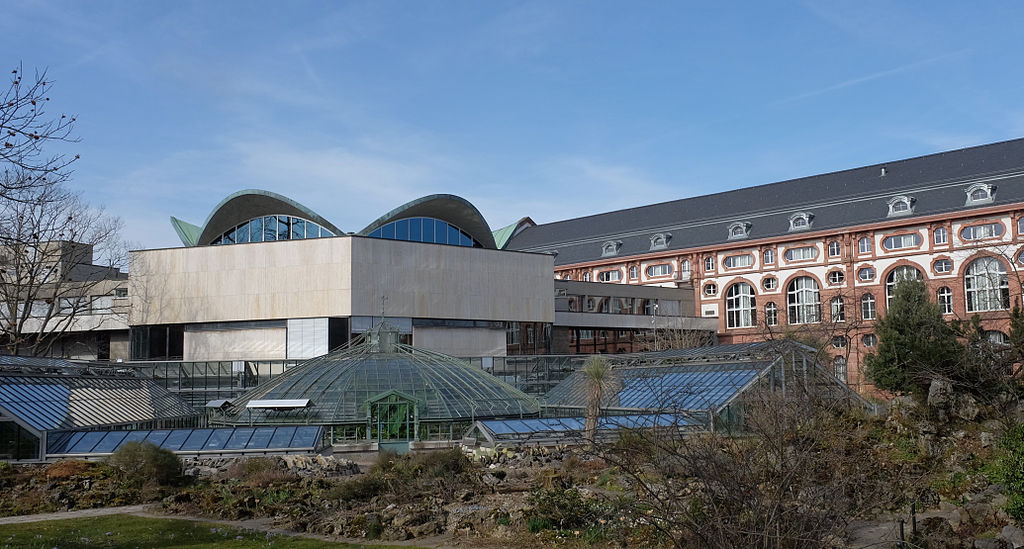
Basel Public and University Library, venue for the Training School
With a strong emphasis on practical experience, this training school is geared towards building the framework for a first multilingual Swiss literary corpus (French, Italian and German). Tasks participating in its construction during the training school will provide an opportunity to discuss pertinent issues.
This course is part of a collective work carried out within the European COST “Distant Reading For European Literary History” project of which the organizers are the Swiss representatives: https://www.distant-reading.net/
The working language of the training school is English, knowledge of at least one of the three languages of the literary data (French, Italian, German) is also required.
All information, including the full training school programme, can be found in French, German, and Italian here and here.
Registration process: target group of the training school isdoctoral students affiliated with the universities of Basel, Bern, Fribourg, Geneva, Neuchâtel and Lausanne as well as from the EPFL. Post-doc researchers can apply via a short email pending registration of PhD students who have priority.
Please register by sending an email to alexandre.camus@unil.ch Participation is free of charge for doctoral students. All travel and accommodation expenses are covered by the doctoral program.
Practical information:
Course title “Distant Reading – Tools and Methods”
Instructors: Simon Gabay, Berenike Herrmann, Simone Rebora, Elias Kreyenbühl
Date: 12 and 13 December 2019
Location: Basel Public and University Library (UB)
https://www.distant-reading.net/wp-content/uploads/distantreading_logo-high-300x138.png00Justin Tonrahttps://www.distant-reading.net/wp-content/uploads/distantreading_logo-high-300x138.pngJustin Tonra2019-11-13 14:55:102019-11-13 14:55:11Invitation to Doctoral Training School: “Distant Reading – Tools and Methods.” Basel, 12-13 December 2019.
The fifth article of the Distant Reading Recommends series is written by Katja Mihurko Poniž of the University of Nova Gorica in Slovenia. She describes Beatin dnevnik / Beata’s Diary, the first novel written in Slovene by a woman writer, and one containing numerous interesting echoes of nineteenth century literature from elsewhere in Europe.
In Distant Reading Recommends, an Action member introduces a novel, published between 1850 and 1920, from one of the participating countries in our Action. These novels may be important or notable within the individual nation’s literary tradition, but less well-known in the broader European context. By bringing these novels to light, we aim to further advance our objectives of creating a broader, more inclusive, and better-grounded account of European literary history and cultural identity.
I am an ardent reader of nineteenth century novels written by women. For a long time, I assumed that this is connected with my undergraduate study in the field of comparative literature where I had to read a great number of the novels written by male authors whereas the novels of women writers were underrepresented. However, since my Ph.D in women’s literary studies I have also read a substantial number of women’s novels. Therefore, I would say that my interest is not only driven by the ethical goal of achieving gender balance in the corpus of the novels I have read so far. I think that the reason for my affection towards women writers is explicable with the fact that their novels written in the long nineteenth century are different in their topics but often also in the narrative style from the writings of male authors. I like these differences and I see them as an enrichment. Let me explain this with an example from the Slovenian literature, taking under the scrutiny the novel Beatin dnevnik (Beata’s Diary) by Luiza Pesjak (1828-1898). Pesjak wrote the sentimental family novel Beatin dnevnik (Beata’s Diary) in 1877 but it was not until 1887 that she managed to publish it. Beatas’s diary is the first novel written in Slovene by a woman writer and it was produced in the period of the early Slovene middle-class novel.
Portrait of Luiza Pesjak (c. 1855) by Mihael Stroj
The novel is written in the form of a diary and is presented throughout as a first-person narration by the eponymous character: the young orphan and governess Beata. In this sense Beata’s Diary is very close to the characteristics of Jane Eyre. As Luiza Pesjak was familiar with English literature, she certainly knew Brontë’s novel. Compared to other female protagonists of Slovenian literature from the period before 1877, Beata is self-assertive, active, and very well educated. The latter is showed when she translates Byron’s Manfred after a collective reading. In this way Pesjak also introduces the motive of incest. It is presented in a reading scene in which Beata, Rihard, and a lady of the castle read Byron’s Manfred. Rihard is a young and attractive man living near the castle who is still in love with Dora, unhappily married stepdaughter of the lady of the castle, and as he is reading Manfred’s words, Byron’s character appears to Beata in a completely different light.
In the novel we can find another intercultural citation which refers to French literature and in particular to George Sand. Alongside Beata in Luiza Pesjak’s novel appears the Frenchwoman Zoé, whom the writer describes as a patriot who left her country after the downfall of Napoleon. She describes Zoé’s grandfather as an officer who was awarded an aristocratic title at Waterloo and her mother as an educated and talented actress of the Comédie Française. It is interesting that a similar relationship – the father from aristocratic circles and the mother from the theatre world – also appears in the family tree of George Sand described in her own Histoire de ma vie, however Pesjak didn’t refer to the French writer with any concrete remarks. She presents Zoé as a companion of an elderly princess who is equally comfortable at court as she is among simple people. The other unusual feature for a Slovene novel is that Zoé and Beata become friends and communicate in French.
Slovene literary history completely overlooked the theme of women’s friendship in Beata’s Diary. This theme is absent in the texts of other nineteenth century Slovene authors in which women are only presented as rivals in the fight for the desired man. In Beata’s Diary women’s friendship is not limited to only the relationship between the two abovementioned characters since Beata also considers Dora and the lady of the castle to be her friends. The community in which the story unfolds is a distinctively female community as there are only three male characters in the novel: the servant Mirko – who is a completely marginal figure, the kind-hearted doctor Kosec, and of course Rihard. This can be understood as a special narrative strategy of deviation from the traditional Slovene novel with a central male character underlining his national allegiance. All of the female characters, with the exception of the princess Pavlovna whose snobbism the narrator rebukes with witty irony, are represented in a very positive way. Their characteristics are not limited to nobility of heart and the ability to empathise with other people’s feelings, but also include intellectual inquisitiveness and cultivation.
The critical attitude towards the traditional role of women is also hidden in the novel, although the narrator does not refer to this directly. However, the reader can reach this conclusion from events in the novel such as Dora’s prearranged marriage and her death during childbirth, as well as Anica’s naivety, abandonment, abuse at the hands of a young aristocrat and subsequent death. All these events testify to the fact that in the nineteenth century women could not decide about their own lives. Despite Beata’s reversal of fortune at the novel’s finale, Pesjak is able to narrate the story of women’s captivity within four walls and their desire to overstep the threshold through the protagonist’s experience of spaces.
Title page of the first edition of Beatin dnevnik
In Beata’s Diary the interiors often bear a negative connotation; they
are described as dark and bringing anxiety, while the exteriors (especially the
garden) are spaces of freedom and creativity. Another of the narrative
strategies is revealed in the author’s decision to make Beata hear the love
story between Anica and the Count in a space which is the complete opposite of
the scenes in which the rest of the novel is set. Beata hears the story when
she dares to step over the marked line upon leaving the
immediate environment of the castle. Her approaching the place where Anica
experienced happiness in love as well as her death is described as the
discovery of a new world, which actually leads to the revelation of the secret.
Beata sees nature as a space of happiness, as an echo of her feelings: “That
mute melancholy, which saddens creation, ruled over nature. It started to rain,
tiny drops were falling, and it rained constantly as if it would never stop. It
corresponded to me so well!”
This quotation shows
Beata’s intensive attention for the events in her environment and her reaction
to them. In the two years, she spent writing the diary, she matures emotionally and her encounters with different life stories shape her
outlook on the world.
Another topic that is omitted in the novels by Slovenian male authors are the representations of motherhood. In Pesjak’s early poems the female characters are idealised images of mothers of the nation, fulfilling the expectations of society by having babies and raising nationally conscious children. However, in Beata’s Diary the topic is developed in more innovative way. It is not only the countess who has a tender relation to her daughters, also Beata often takes on the maternity role. And there is also a motive of a mother who lost her child presented in Anica’s story which is communicated to Beata through Anica’s mother.
What I like the most in this novel is Beata’s personal development. From the girl whom Rihard initially did not even notice, she turns into a woman who proves she is independent and dedicated to her work, which she carries out successfully. Even though she also conquers Rihard’s heart by looking after him in his illness, all of Beata’s activities derive from her own motives. The fact that at the end she finds happiness with a man she loves and who loves her can be seen as the typical ending of a romance novel, but on the other hand it could also represent the author’s desire for women’s independence and ambitiousness to be compatible not only with renouncement and even death but also with happiness in love. Since the female figures in the novels of the Slovenian male authors are either passive girls without their own will or dangerous femmes fatales who are punished in the end for their boldness in transgressing the gender boundaries, Beata’s Diary is one of my favourite Slovenian novels.
Beatin dnevnik is included in the Slovenian corpus of ELTeC, and can be read here. For further reading, see:
Elaine Showalter: A Literature of Their Own. Princeton: Princeton University Press, 1977.
Lilian Faderman: Surpassing the Love of Men: Romantic Friendship and Love Between Women from the Renaissance to the Present. William Morrow & Company, 1981.
Susan S. Lanser: Fictions of Authority: Women Writers and. Narrative Voice. Ithaca and London: Cornell University Press, 1992.
This updated version of the original article was posted on 3 January 2020.
The fourth article of the Distant Reading Recommends series comes from Serbia, and is written by Cvetana Krstev of the University of Belgrade and Vasilije Milnovic of the University Library “Svetozar Markovic,” University of Belgrade. They introduce a prominent oriental-themed novel from the Serbian tradition, puzzlingly neglected today but notable for its formal and thematic innovations.
In Distant Reading Recommends, an Action member introduces a novel, published between 1850 and 1920, from one of the participating countries in our Action. These novels may be important or notable within the individual nation’s literary tradition, but less well-known in the broader European context. By bringing these novels to light, we aim to further advance our objectives of creating a broader, more inclusive, and better-grounded account of European literary history and cultural identity.
Jelena J. Dimitrijević (1862 – 1945) was a Serbian writer, but also a world traveler and benefactor. Ignored and neglected far too long, Serbian culture has only recently become reacquainted with her voluminous opus.
Jelena was born in Kruševac, to a merchant’s family, as the tenth child. Her mother’s family was highly regarded, comprising several well-known scholars and artists, and it also bore a princely title. After the marriage to Serbian Army Lieutenant Jovan Dimitrijević, she permanently settled in Niš. Residing in a big city and marrying a well-educated and open-minded Dimitrijević opened up new perspectives for her and developed her lasting love for the Orient. This was particularly prompted by her intense socializing with prominent Turkish women in Niš, but also in Thessaloniki, Istanbul and Skopje, where she was a frequent and welcome guest. In her subsequent opus, that included the novel “The New Women (Nove),” Jelena elaborated in a creative manner the intimacy of these gatherings and her familiarity with the daily life of Muslim women in the Balkans.
Jelena J. Dimitrijević
By the end of the nineteenth century, she moved with her husband to Belgrade, where she would live for the rest of her life. The First World War founds her in Germany, from whence she returned to Serbia via Switzerland, Italy and Greece. After the war and the death of her husband on the front, trips to France, Spain and England followed, from where she traveled to America. With the same passionate fervour with which she illuminated the well-kept secrets of the everyday life of Muslims, she also discovered the way of life of American women, describing them in a picturesque way in a travelogue Novi svet ili u Americi godinu dana (New World or One Year in America) in 1934. In 1926 she made her way to the East, to Egypt, Palestine, Syria, and Lebanon. She went to see Alexandria, Cairo, Memphis, Luxor, the Holy Land, and Jerusalem, Damascus, Beirut, and Haifa. Of importance is her encounter in Egypt with the famous feminist Huda Sha’arawi, president of the Egyptian Feminist Union. From Egypt she traveled to Bombay, where she also stayed with a famous feminist, Mrs. Tate From there, she traveled to China, Japan, and Ceylon. Her impressions of this voyage were published in her travelogue Sedam mora i tri okeana (Seven Seas and Three Oceans) in 1940.
The novel Nove (The New Women) was published in 1912 and immediately attracted the attention of the professional public, receiving an award from the Serbian Literary Cooperative (Srpska književna zadruga). This novel was recommended for publication by the Serbian Literary Cooperative by the well-known literary historian and distinguished professor at the University of Belgrade, Pavle Popović, who had followed Jelena since her early poetic works, and pointed out that her verses should be given “special importance” due to their quality.
Bust of Dimitrijevic
In a letter to her friend Lujza St. Jakšić, dated 2 August 1908, Jelena Dimitrijević explained the reasons for her journey to Thessaloniki, anticipating in fact the action of a future novel: “I went there with great joy and curiosity: I will see the ones I love and who love me, I will find out how they feel now when they became developed, whether old Turkish women are blushing with shame, do they still don scarves on their heads out of habit, are they able to walk along with people and do the new ones rejoice, were there enough hats for all of them in Thessaloniki or are some of them bare-headed.” Her excellent choice of the moment of Young Turk social changes in the novel Nove offers a vivid and unique testimony about the everyday life of Turkish women in Thessaloniki, torn between the anachronistic role of women in traditional Islamic society and the modern requirements of upbringing “in the Western fashion.” The rigorous partitions in traditional Islamic society, with very clear rules, presented constraints to new, young Turkish women, which they faced at every step of their daily lives. When they tried to make their dreams come true, although they were often entirely hazy, lacking experience and idealistic, they fell victim to the dire collision of old and new, Eastern and Western, traditional and modern.
This is portrayed in a very suggestive way through the fate of the main character of the novel, Emir-Fatma. She is the character with all the prerequisites for accomplishing a successful woman’s role in the society, which in this case means the traditional role of a woman deep behind closed doors. Yet she is one of the “new” women, and so is her intimate friend and cousin Mersija, educated on Western European values and French novels, and as such, deeply dissatisfied with the moulds of traditional Ottoman society, which has itself been pretty well weakened by the coming social changes. The vibrant atmosphere of the reality of that time and place in this novel is full of anthropologically intriguing images of women’s lives in the harem, i.e. the feminine part of the house, strictly separated from the men’s world, in which lesbian love often developed, presented in the novel through Emir’s longing for a French female teacher. Traditional regulations are especially evident in the marital problems of Emir-Fatma and her chosen one, Jamal. These regulations entail another essential characteristic of the Oriental world: intrigue. It is through intrigue that Emira marries her chosen one. Through intrigue, because of his alcohol problem, a sin worthy of contempt in the traditional Islamic world, she divorces him as many as three times. Through intrigue, she marries another man, aware of his nature, with the intention of being banished by him so that she can return to her chosen one and thus outsmart the traditional regulations. After her traditional father Hassan-bey refuses to let her daughter marry again the same man with scorn worthy vices, Emir – until then obedient to her father’s will – now openly opposes him for the first time, but in this case the only thing left to Emir-Fatma and Jemal in the context of traditional Ottoman society, is an escape to Paris. In this they will be helped by the skillful intrigues and networks of experienced women, and above all by her aunt Aruf-Hanum, herself also a representative of the “new” ones.
After the arrival of Emir to the much-desired West, through her diary notes that reach Aunt Aruf, the novel provides a testimony of unfulfilled women’s dreams and her sufferings in that same West: unable to live as a traditional Turkish woman in Thessaloniki, Emir-Fatma could not also live in Paris as a European. A year after his daughter’s escape, a granddaughter arrives to Hassan-bey, followed by the news of Emir’s death and the telling Emir’s last will: a request for her father that her daughter be educated solely following the traditional patterns.
The novel’s anthropological and documentary detail contributes to its constant re-readings within feminist, narratological, or orientalist approaches to the study of literary work. From today’s point of view of particular interest is the formal procedure in the novel, which is told in the third omniscient person. However, letters and diary notes, always given in the first person, are also interpolated into this narrative. In addition to the overt depictions of lesbian and incestuous desires, concealed by the drapes of traditional Ottoman society, a particular contribution to the modernity of this novel are also explicit feminist viewpoints, very atypical of the literary context of the time.
Therefore, it is perplexing that this novel, the only one published during the author’s life and awarded immediately after its release from the press, has fallen into oblivion after the death of Jelena Dimitrijević. However, precisely because of all of the above, it should come as no surprise that, at the beginning of the twenty-first century, the interest of both expert and wider audiences for this masterpiece of Serbian literature continues to grow.
Nove is included in the Serbian corpus of ELTeC, and can be read here. For further reading, see:
Jelena Dimitrijević – život i delo: zbornik referata sa naučnog skupa, Niš, 28 i 29. Oktobar 2004: Centar za naučna istraživanja SANU I Univerzitet u Nišu, 2006. ISBN – 86-7025-406-9. COBISS.SR – ID: 133976332.
Čitate li Jelenu Dimitrijević?: zbornik radova, Beograd, Filološki fakultet 2018. ISBN – 978-86-6153-480-5. COBISS.SR – ID: 259682060.
Knjiženstvo: teorija i istorija ženske književnosti na srpskom jeziku do 1915. godine. Beograd, Filološki fakultet 2015. ISBN – 978-86-6153-306-8. COBISS.SR – ID: 217916428.
Biljana Dojčinović-Nešić, “Čarobni san istoka – stvarnost u romanu `Nove’ Jelene Dimitrijević”, izlaganje na konferenciji, 2007, COBISS.SR-ID: 514249902.
https://www.distant-reading.net/wp-content/uploads/rs_dimitrijevic_1.jpg600391Justin Tonrahttps://www.distant-reading.net/wp-content/uploads/distantreading_logo-high-300x138.pngJustin Tonra2019-09-24 10:54:022019-11-06 15:32:07Distant Reading Recommends: Nove (The New Women) by Jelena Dimitrijević
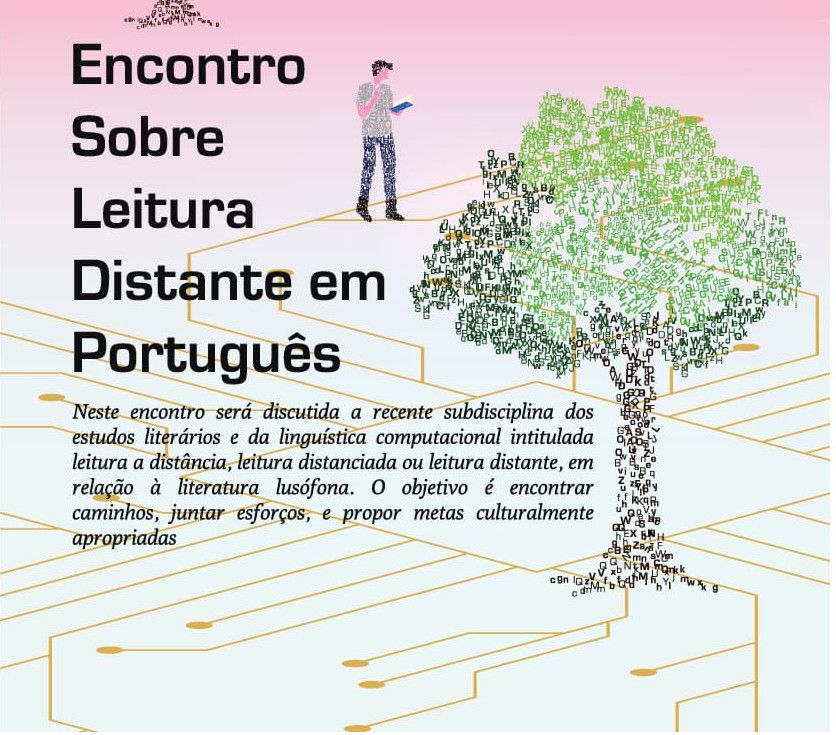
The First Workshop on Distant Reading in Portuguese will take place on 27-28 October 2019 at the University of Oslo, and will feature a presentation on our COST Action on Distant Reading for European Literary History by Isabel Araújo Branco, Diana Santos, Paulo Silva Pereira and Raquel Amaro.
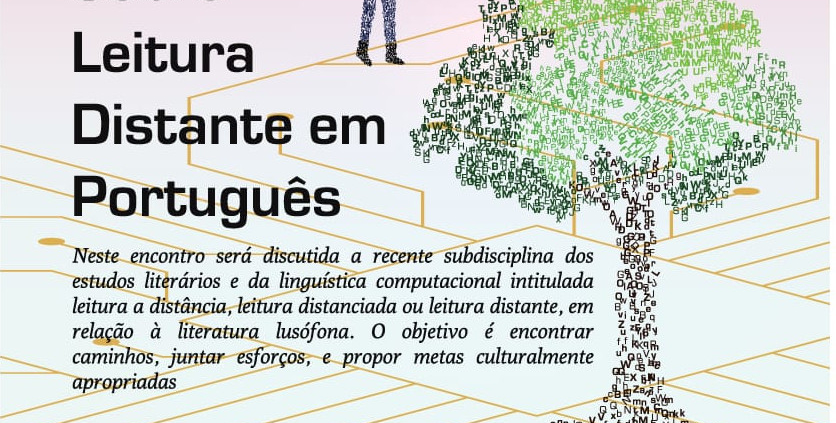
Leitura distante em Português (Distant Reading in Portuguese) Image created by Oriel Wandrass, Universidade Estadual do Maranhão (UEMA)
At the conference, which features additional presentations by members of our Action, participants will illustrate the state of the art, discuss research questions for the medium and long term, and to take a position on several Portuguese-related matters within the sphere of Distant Reading.
Further details, including the programme of the workshop and abstracts, are available here: Portuguese | English (via Google Translate).
We are very happy to announce that Action members Roxana Patraș and Ioana Galleron received approval for funding their project HAI-RO (Hajduk Novels in Romania During the Long Nineteenth Century: Digital Edition and Corpus Analysis Assisted by Computational Tools) within the “Brâncuși” Program for Integrated Actions. Even if the acronym HAI-RO originally stood for “Romanian hajduk” we like to think of it more in the terms of its literal translation: “Come on, Romania!”
Roxana Patraș and Ioana Galleron
The program rests on an enthusiastic collaboration between the “Alexandru Ioan Cuza” University of Iași and Université Paris 3 Sorbonne Nouvelle, which started when the project’s principal investigators decided to experiment on a series of TEI-XML novels for ELTeC (the “European Literary Text Collection” developed within the Distant Reading COST Action. This further lead to the formation of a French-Romanian team whose members are Camelia Grădinaru, Ioana Lionte and Alexandra Oltean (both of them Training School grantees), Lucreția Pascariu, Chiara Mainardi, and Ofra Lévy.
Alexandra Olteanu, Lucreția Pascariu, and Camelia Grădinaru
In a nutshell, the project seeks to remedy the shortcomings of the resources and tools specially designed for the Romanian Computational Literary Studies. The research will focus on the characterisation of the features that are inherent to “the hajduk literature” by adapting the specific instruments of corpus linguistics to the specificities of literary texts printed in non-standardised Romanian. This will be completed with an analysis of the external features developed along the historical evolution of a literary genre that has generally been labelled as “national”.
The main result of the project will be the creation of a Romanian literary corpus (1850-1950) conformant with the XML-TEI international standard of digital editing and including semantic annotations. The project will be accessible on an Open Access basis and will be stored on the Nakala platform (France) and signalled on HAL-SHS. In accordance with its scientific objectives, the project will produce a schema and an annotation guide for spatial terms, both adapted to literary texts. It will also provide a rich input for the Romanian collection of ELTeC.
https://www.distant-reading.net/wp-content/uploads/hairo1.jpg6391136Justin Tonrahttps://www.distant-reading.net/wp-content/uploads/distantreading_logo-high-300x138.pngJustin Tonra2019-08-28 13:43:592019-10-12 13:07:43The HAI-RO project: a new offshoot of the Distant Reading COST Action
The third article of the Distant Reading Recommends series is written by Ellie Boyadzhieva of the South-West University of Blagoevgrad in Bulgaria. She describes a prominent revolutionary novel from the Bulgarian tradition whose enduring popularity is felt to this day.
In Distant Reading Recommends, an Action member introduces a novel, published between 1850 and 1920, from one of the participating countries in our Action. These novels may be important or notable within the individual nation’s literary tradition, but less well-known in the broader European context. By bringing these novels to light, we aim to further advance our objectives of creating a broader, more inclusive, and better-grounded account of European literary history and cultural identity.
The
novel Под игото (Under the Yoke) was written
by Ivan Vazov, who is commonly referred to as “the Patriarch of Bulgarian
literature” by Bulgarian literary historians.
Ivan Vazov (1850-1921) lived on the border of two eras and his numerous literary works depict two significant periods of Bulgarian history: the Renaissance and the Post-Liberation epoch. During his lifetime he was also a prominent public figure who exerted a huge influence on Bulgarian literary and cultural life.
Ivan Vazov
He wrote Under the Yoke in Odessa (today’s Ukraine) where, in 1886, Vazov was forced into exile because of the persecution of the Russophile political faction of which he was an active member.
The novel consists of three parts. The first part was published in 1889 in the periodical Collection of Folk Lore, Science and Literature, and the other two parts were published in the same volume in 1890.
The first English edition of Under the Yoke (1894)
Curiously enough, Under the Yoke was first published as a separate volume in English in 1894. The British editor William Heinemann included it as № 14 in his newly-founded series, Heinemann’s International Library, which published English translations of classical authors from all over the world. In this way, the novel was designated as a world literary classic on its initial publication. Later on in the same year, Under the Yoke was published in Bulgaria by T. F. Chipev. In the subsequent years three more Bulgarian editions appeared. Today Под игото is translated into over 30 languages, including Japanese.
The subtitle of the novel is “From the Life of the Bulgarians on the Eve of the Liberation,” as it depicts the heroic time leading to the April Uprising against Ottoman rule in 1876 and its subsequent cruel suppression.
The first Bulgarian edition of Под игото (1894)
The main
protagonist in the novel, Boycho Ognyanov, is a romantic character: a
personification of the revolutionary spirit in Bulgaria on the eve of the April
Uprising. He is a brave and glamorous leader of the national liberation
movement and a representative of the young Bulgarian intelligentsia.
The location where the action develops is the small mountainous town of Bjala Cherkva (White Church) in the spring of 1875. The first scene depicts a peaceful dinner in the home of Chorbadzhi Marko which is suddenly interrupted by a startling noise of falling bricks. Marko goes to check out what is happening and recognizes Ivan Kralicha, an outlaw who has managed to escape from Diyarbakir [1]. The Turkish soldiers are knocking on Marko’s gate and Kralicha runs away. He takes shelter in a windmill outside the town where he kills two Turks to save the life of the miller and his little daughter. The miller helps him to bury them and takes him to the nearby monastery. Later he meets Doctor Sokolov and the two young men become friends as they share one and the same ideal: the liberation of Bulgaria from Ottoman rule. Sokolov invents a new identity for Kralicha under which he enters the community of Bjala Cherkva [2].
Ognyanov is hired as a teacher. This allows him to settle down in the town and to preside over the secret revolutionary committee. He saves the reputation of the young teacher Rada Gospozhina at the yearly exams in the girls’ school, and receives the approval of all honest town folk. Everything goes smoothly until one of the schoolgirls unintentionally reveals revolutionary accounts she overheard at home, causing chaos. After that episode Rada and Ognyanov fall in love.
The story unfolds by depicting the preparation for the uprising, which changes the lives of many of the characters and finishes with the defeat of the revolt. Ognyanov, Sokolov and Rada sacrifice their lives in the final battle with the Turks.
Bulgarian literary historians unanimously agree that Under the Yoke is the first historical novel and the most famous novel in the Bulgarian literary tradition that has influenced other fiction written in this period and thereafter. Although the main theme is uniquely Bulgarian, the author’s technique of narration with sudden turning points, escalating suspense, and unexpected climaxes, is deeply influenced by French romanticism and especially by Victor Hugo’s historical novels. For over 50 years it has been included in the Bulgarian secondary school curriculum, and is still revered by Bulgarian readers. In 2009, the novel was voted as Bulgaria’s favourite novel in the “Big Read” campaign, organised by Bulgarian National television.
Read the text of Под игото, which will soon be included in the Bulgarian contribution to ELTeC. For further reading, see:
‘Под игото’ и езикът , // В: Ракьовски, Цв. “Литературата и езикът”, Велико Търново, “Фабер” 2014: 20-28.
‘Произведения на Иван Вазов’. Уикипедия, 2 May 2019. Wikipedia.
[1] Diyarbakir is a fortified city in Turkey, which during the Ottoman rule was used as a prison for political convicts from the Christian parts of the Empire.
[2] His new name is Boycho Ognyanov, which is a symbolic
name. Boycho derives from бой,
meaning fight and Ognyanov derived from огън, meaning
fire.
https://www.distant-reading.net/wp-content/uploads/bg_ivan_vazov.jpg1079752Justin Tonrahttps://www.distant-reading.net/wp-content/uploads/distantreading_logo-high-300x138.pngJustin Tonra2019-06-11 15:17:032019-11-06 15:39:30Distant Reading Recommends: Under the Yoke by Ivan Vazov
The COST Action Distant Reading for European Literary History is issuing a Call for Applications for its third Training School, hosted by the Centre for Digital Humanities – Eötvös Loránd University in Budapest from September 23 to 25, and co-located with the DH_Budapest 2019 conference http://elte-dh.hu/conf2019/.
Note that participation is free of charge! Applicants may apply for one of the grants for participation in one of the 3 parallel tracks: TRACK 1: Corpus design and text contribution for ELTeC TRACK 2: Natural Language Processing for Distant Reading TRACK 3: Canonization in Distant Reading Research
To apply, please see the information and instructions in the full Call for Applications. Applications will be sent to Roxana Patras (roxanapatras82@gmail.com) and Christof Schöch (schoech@uni-trier.de) before June 25th, 2019until July 15, 2019. In case you have questions regarding the call, the application process or the Training School, please contact Roxana Patras, the Action’s Training School Coordinator (roxanapatras82@gmail.com).
Beside the participation in one of the 3 parallel tracks, there are also opportunities for all Training School participants to register for and participate in the DH_BUDAPEST 2019 conference, held in Budapest and directly following the Training School, from September 25 to 27, 2019! Information will be available on the conference page http://elte-dh.hu/conf2019/ca_ts/.
https://www.distant-reading.net/wp-content/uploads/distant-reading_icon_v3a.png286301Christof Schöchhttps://www.distant-reading.net/wp-content/uploads/distantreading_logo-high-300x138.pngChristof Schöch2019-06-02 16:33:212019-10-12 13:20:36Call for Applications for the third Distant Reading Training School: Budapest, 23-25 September 2019 (extended deadline! July 15, 2019)
The second article of the Distant Reading Recommends series is written by Roxana Patras of “Alexandru Ioan Cuza” University of Iasi in Romania. Her piece describes a notable hajduk novel, from a genre which followed the adventures of these romanticised hero figures of the Balkans.
In Distant Reading Recommends, an Action member introduces a novel, published between 1850 and 1920, from one of the participating countries in our Action. These novels may be important or notable within the individual nation’s literary tradition, but less well-known in the broader European context. By bringing these novels to light, we aim to further advance our objectives of creating a broader, more inclusive, and better-grounded account of European literary history and cultural identity.
Around 1855, when French, English, German and Hungarian translations of Romanian ballads started to be published, Iancu Jianu did not look like an epitome of the Romanian hajduk. Thus, translators such as Jules Michelet, Henry Stanley, Wilhelm von Koetzebue, Karoly Acs or Vasile Alecsandri went for texts that featured braver outlaws, whose names were spelled in funny westernised versions: “Mihou” ou “Michu”, “Toma Alimoche” or “Thoma Alimosch”, “Boujor”, “Kodran”. Attested from the sixteenth to the nineteenth century and spread throughout the entire Central and South-Eastern Europe (Rodopi Mountains, Srena Gora, Stara Planina, Olympus Mountains, Romania Mountain in Bosnia), the Bulgarian haiduti/hayduds, the Serbian hajduks, the Greek klephts, the Albanian kaçaks, the Ukrainian cossacks, the Croatian uskoks, and the Romanian haiduci were known as paramilitary organisations championing democratic decision-making, rebellion against the feudal privileges and chiefly against the Ottoman rulers, a sort of alternative proto-socialist economy and a nomad lifestyle. The hajduk literature, ballads and derived genre fiction, is thus specific to the entire Balkan area, its regional development being favoured by shared geographic, economic, social, and cultural conditions.
Indeed, Jianu’s ballad is considerably shorter and looks lesser adventurous than others of the same type. Living between 1787 and 1842, also being Tudor Vladimirescu’s right-hand man during the 1821 Revolution, it seems that the Romanian hajduk would survive his dying legend and probably witness the decay of his own text (allegedly authored by himself) into bits of drinking songs, as the ones assembled by Anton Pann’s in his colportage collections. Surprisingly, a decade after his death, Iancu Jianu was resurrected as a die-hard literary character and as a national symbol that, for over a century and a half, would enthrall a lot of Romanian writers, composers, film and stage directors.
Images from editions of Popescu’s Iancu Jianu
A young and very energetic aspirant named Nicolae D. Popescu (1843-1921) speculated the success of melodramas and vaudevilles authored and directed by Matei Millo around 1855 and turned the dramatis persona into a sensational character. The resulting novel was issued in no fewer than 7 editions, comprising 5000 copies each. Taking into consideration the social, cultural and economic context, especially the low levels of literacy during the period of its publication, we might say that these are numbers that indicate market success, professionalisation of writing and enforcement of literary institutions. Gaining fame with this simple trick of rewriting recent national history as sensational literature, N. D. Popescu came to be acclaimed as “Romania’s Ponson du Terrail,” as the unchallenged master of nineteenth-century Romanian pulp fiction. Indeed, he wrote around 60 novels, the majority of them belonging to the hajduk genre.
Between 1868 and 1916, the novel series Iancu Jianu grew in complexity from a structural, thematic and symbolical point of view, at the same time accommodating new historical and ethnographic content coming from scholars who were assiduously researching the hajduk’s biography. As the author himself avers in several prefatory notes, the story about the publication and growth of this series is as spectacular as the hero’s life. While the first edition was actually a newspaper installment and did not exceed the average length of a short-story, the second and the third editions, published in 1872 and 1881, were issued in response to readership demand. Apparently, the hagiographical structure of the fourth edition (1887) was an innovation inspired by Jianu’s recently-revealed autobiography and by a series of unknown documents and testimonies such as those published by Gr. G. Tocilescu, V. A. Urechia, and C. D. Aricescu around 1880; so, the novelist would now deliver the same novel in two mirrored parts that presented the hero’s deeds and temper before and after his conversion to an outlaw’s lifestyle: (a) Iancu Jianu, Zapciu/Iancu Jianu, the County-Tax Collector and (b) Iancu Jianu, Haiducul/Iancu Jianu, the Hajduk.
But the character sold too well for the publishers not to try more profitable typographic formulae or easy-going copyright transfers. The fifth edition had a third part, where the novelist developed the circumstances of Iancu Jianu’s death. The sixth edition (1912) returned to the hagiographical pattern, while the seventh edition (1912) seemed to be an aggregate of the previous ones.
Illustrations of Iancu Jianu
Why does Iancu Jianu decide to become a hajduk in king Caradja’s times? Beside his sister’s/his betrothed one’s elopement, beside his brothers’ plundering of properties, beside the strong ideological commitment to Φιλική Εταιρεία/Filiki Eteria and Tudor Vladimirescu’s riot against the Ottoman Empire, there is something about Iancu Jianu that places him in Karl Moor’s descent and makes him the most romantic Romanian hajduk of them all. Apart from his particular social status—he is an aristocrat offspring, while his kinds are rebellious peasants—it is his deep melancholy, his inexplicable longing for loneliness, isolation and perhaps self-extinction that express a modern consciousness, a troubled sense of identity, an intellectualised manner of acting. Indeed, his decision to commit himself to a hajduk lifestyle, his surrendering to the Phanariote militia and escape from the salt mine, his love affair with his host (Catinca/Ilinca/Stăncuța) and then the forced marriage to Sultana look like not entirely assumed acts, as if the hero is not thoroughly participating in his own life and story.
Taking into consideration the author’s massive interventions on the original text during half a century (1869-1912), Iancu Jianu, Haiducul could hardly be defined as a single novel. It should be considered more of a work-in-progress series. Certainly, there is magic about it, as the hajduk leader’s brave deeds and abyssal personality attracted not only N. D. Popescu’s imitators (Panait Macri, Panait Popescu, Anton Marcu, Ilie Ighel, T. M. Stoenescu, Ștefan Stoenescu, Alexandru Munte Stânceanul, Lazăr, Simion Bălănescu), but also accomplished writers such as Bucura Dumbravă or Panaït Istrati. They exported Iancu Jianu and the hajduk type through novels that were published in Germany (Der Haiduck, Der Pandur) and France (Présentation des Haïdouks). The force of this literary myth is also illustrated by a legion of texts, movie scripts, movie series and musicals that were produced under the Communist regime.
I remember that, during the 1980s when the programme of the Romanian national television was severely limited to 2 hours a day, the movie series Haiducii/The Hajduks, Pintea Haiducul/Pintea, the Hajduk, and Iancu Jianu were anticipated with restless excitement and watched in stunned admiration. Directors Dinu Cocea and Mircea Moldovan would avail of Romania’s isolation and deliver to the communist audiences a kind of Balkan western. This is another proof that Iancu Jianu, Haiducul should be recommended not only as a text authored by N. D. Popescu and restyled by many others, but also as a complex cultural phenomenon whose stretching in time and whose variety of artistic extensions makes it a perfect topic for distant-reading research.
Acknowledgements:
According to Dictionarul Cronologic al Romanului Romanesc (The Chronological Dictionary of the Romanian Novel), N. D. Popescu wrote the following novels featuring Iancu Jianu:
Iancu
Jianul, căpitanul de haiduci,
Bucharest, Editura Librăriei H. Steinberg, 1873, 140 p.
Iancu
Jianu, zapciu de plasă. Nuvelă originală, Bucharest, Editura Librăriei H. Steinberg, 1887, V + 120
p.
Moartea
lui Iancu Jianu, căpitan de haiduci. Nuvelă originală, Bucharest, Editura Librăriei H. Steinberg,
1894, 176 p.
Tinereţea
lui Iancu Jianu, vestit căpitan de haiduci, Bucharest, Tip. Concurenţa, 1909, 164 p.
Jancu
Jianu, polcovnic de poteraşi,
Bucharest, Tip. Concurenţa, 1910, 148 p.
Scăparea
lui Jancu Jianu din ocna părăsită,
Bucharest, Tip. Concurenţa, 1911, 178 p.
Dragostea
lui Iancu Jianu cu Smaranda Gălăşeasca. Nuvelă originală, Bucharest, Tip. Concurenţa, 1916, 174
p.
Prinderea
lui Iancu Jianu căpitanul de haiduci. Nuvelă originală, Buc., Tip. Concurenţa, 1916, 143 p.
Versions of Iancu Jianu editions as well as other Romanian
hajduk novels are available on Zenodo:
Many thanks to Cornelia Viziteu and to the librarians of Botoșani County Library, who provided me with scanned copies of several volumes from the “Iancu Jianu” series.
For further reading, see:
Joep Leersen et al, The Rural Outlaws in East-Central Europe. In Cornis-Pope, Marcel & Neubauer, John (eds.) (2010), History of the Literary Cultures of East-central Europe, vol. 4. Types and stereotypes. Amsterdam & Philadelphia: John Benjamins.
Bracewell, W. (2003). The Proud Name of Hajduks: Bandits as Ambiguous Heroes in Balkan Politics and Culture. In Norman M. Naimark and Holly Case (eds.), Yugoslavia And Its Historians. Stanford, California: Stanford University Press.
Dicționarul cronologic
al romanului românesc
(2003). Vol. 1. Bucharest: Editura Academiei Române.
Dicționarul literaturii române de la origini până la 1900 (1979). Bucharest: Editura Academiei RSR.
Hobsbawm, E. (1959). Primitive Rebels: Studies in Archaic forms of Social Movements in the 19th and 20th Century. New York: Norton.
https://www.distant-reading.net/wp-content/uploads/ro_1_covers_Jianu-editions.jpg7121273Justin Tonrahttps://www.distant-reading.net/wp-content/uploads/distantreading_logo-high-300x138.pngJustin Tonra2019-05-07 11:35:322019-11-13 14:35:43Distant Reading Recommends: Iancu Jianu by N. D. Popescu
We may request cookies to be set on your device. We use cookies to let us know when you visit our websites, how you interact with us, to enrich your user experience, and to customize your relationship with our website.
Click on the different category headings to find out more. You can also change some of your preferences. Note that blocking some types of cookies may impact your experience on our websites and the services we are able to offer.
Essential Website Cookies
These cookies are strictly necessary to provide you with services available through our website and to use some of its features.
Because these cookies are strictly necessary to deliver the website, refusing them will have impact how our site functions. You always can block or delete cookies by changing your browser settings and force blocking all cookies on this website. But this will always prompt you to accept/refuse cookies when revisiting our site.
We fully respect if you want to refuse cookies but to avoid asking you again and again kindly allow us to store a cookie for that. You are free to opt out any time or opt in for other cookies to get a better experience. If you refuse cookies we will remove all set cookies in our domain.
We provide you with a list of stored cookies on your computer in our domain so you can check what we stored. Due to security reasons we are not able to show or modify cookies from other domains. You can check these in your browser security settings.
Other external services
We also use different external services like Google Webfonts, Google Maps, and external Video providers. Since these providers may collect personal data like your IP address we allow you to block them here. Please be aware that this might heavily reduce the functionality and appearance of our site. Changes will take effect once you reload the page.
Google Webfont Settings:
Google Map Settings:
Google reCaptcha Settings:
Vimeo and Youtube video embeds:
Privacy Policy
You can read about our cookies and privacy settings in detail on our Privacy Policy Page.